
Using AI to strengthen the research & design process. Not replace it
ClearVisit involved a multifaceted design process that required extensive research, organization, and the development of a scalable design system. By integrating AI tools into my workflow, I was able to streamline research preparation, explore potential user needs, and simplify the process of building and documenting design tokens. This approach allowed me to work more efficiently while maintaining ownership of the creative direction, UX decisions, and overall product experience. While AI improved efficiency throughout the process, it also introduced inaccuracies that reinforced the importance of human judgment and oversight.
Research
I began by conducting secondary research to identify common challenges patients face when scheduling medical appointments. After gathering insights from credible sources, I used ChatGPT to support my analysis by comparing findings, identifying recurring themes, highlighting conflicting evidence, and uncovering potential gaps in the research. Rather than relying on AI to draw conclusions, I used it as a tool to challenge my initial assumptions and explore questions that warranted further investigation. This helped me organize the research more efficiently while keeping human judgment at the center of the process.
To guide this analysis, I entered the following prompt into ChatGPT:
Act as a UX research assistant. Review the following secondary research about healthcare scheduling. Identify assumptions, conflicting evidence, and unanswered questions. Suggest neutral interview questions for patients and scheduling coordinators. Do not invent research findings or personas. Separate evidence from hypotheses.
https://www.mgma.com/mgma-stat/meeting-pressure-on-patient-digital-self-scheduling
https://www.experian.com/blogs/healthcare/the-state-of-patient-access-2026/
Within approximately 3 seconds (10:11:37 PM–10:11:40 PM), ChatGPT returned a structured analysis highlighting recurring themes, potential research gaps, conflicting evidence, and unanswered questions. This provided a starting point for further evaluation, allowing me to focus on interpreting the findings, assessing their relevance, and identifying opportunities for additional research.
Key Research Findings & User Needs
Conflict 1: High interest versus low adoption
Experian reports strong patient interest in anytime scheduling, while MGMA reports relatively low self-scheduling usage.
Possible explanations (unverified): Limited appointment types, unfamiliar interfaces, lack of awareness, or patients preferring staff assistance for complex visits.
Research question: What influences a patient's choice of scheduling channel?
Patients want faster access, yet providers report insufficient appointment slots and staffing constraints.
Possible explanation (unverified): A patient might complete a booking process easily but still be dissatisfied with the avaiable dates.
Research question: How do patients distinguish booking difficulty from waiting too long for an appointment?
Conflict 3: Digital scheduling versus missed appointments
MGMA's 2025 research associates higher self-scheduling adoption with perceived improvements in no-shows. However, its August 2026 poll found that 32% of medical groups reported higher no-show rates than in 2025, 58% reported similar rates, and 10% reported lower rates.
Possible explanation (unverified): Scheduling methods may be only one factor among affordability, transportation, work obligations, and appointment lead times.
Research question: What circumstances influence whether patients ultimately attend their appointments?
Conflict 4: Provider assumptions versus patient-reported reasons
MGMA cites a 2026 Tebra survey in which 81% of providers identified forgetting as a leading cause of no-shows, whereas patients more often reported work conflicts (31%), weather (30%), and emergencies (27%).
Possible explanation (unverified): Providers may not consistently receive or capture patients' reasons for missing appointments.
Research question: How do scheduling teams learn why appointments are missed, and how does that information affect their decisions?
Building on ChatGPT’s initial analysis, I first used ChatGPT to analyze existing industry research, identify potential research gaps, and develop neutral interview questions for both patients and clinic scheduling staff.
Suggest neutral interview questions for patients and scheduling coordinators. Do not invent research findings or personas. Separate evidence from hypotheses.
Patient interview
| Topic | Interview question | Optional neutral probe |
|---|---|---|
| Recent experience | Tell me about the last time you scheduled a healthcare appointment. | What happened from beginning to end? |
| Channel choice | How did you decide how to schedule it? | What other options, if any, did you consider? |
| Finding care | How did you determine which provider or appointment type you needed? | Was there anything you needed to clarify? |
| Availability | What options were available when you scheduled? | How did those options fit your needs? |
| Digital tools | Tell me about any experiences you’ve had scheduling appointments online. | What worked well or less well? |
| Information | What information did you need before confirming the appointment? | Where did you find that information? |
| Costs | What role, if any, did expected costs or insurance coverage play? | When did you learn about those details? |
| Changes | Tell me about the last time you needed to change or cancel an appointment. | What steps did you take? |
| Attendance | What factors make it easier or harder for you to attend a scheduled appointment? | Can you recall a specific example? |
| Improvements | Thinking about your recent experiences, what, if anything, would you change? | Why would that change matter to you? |
Scheduling coordinator interview
| Topic | Interview question | Optional neutral probe |
|---|---|---|
| Responsibilities | Walk me through your responsibilities related to scheduling. | How does your work vary throughout the day? |
| Workflow | Tell me about the last appointment you scheduled for a patient. | Which systems or resources did you use? |
| Appointment rules | How do you determine which appointment type and provider are appropriate? | What happens when the information is incomplete? |
| Availability | How do you identify available appointment times? | What affects whether a slot can be offered? |
| Exceptions | Tell me about a recent appointment that required extra coordination. | What made that situation different? |
| Digital scheduling | How do appointments booked online enter your workflow? | What, if anything, requires staff review? |
| Changes | What happens when a patient cancels or requests a different time? | Who is responsible for the next step? |
| No-shows | How does your team handle appointments that patients do not attend? | What information is available about why? |
| Insurance | What role do insurance verification and authorization play in scheduling? | At what stage are issues identified? |
| Tools | Which systems do you use during a typical scheduling task? | How do you move information between them? |
| Prioritization | How do you decide what to work on when multiple requests arrive? | Can you describe a recent example? |
| Improvements | Which parts of your scheduling work would you change, if any? | What would a successful change look like? |
I then used Claude to generate four simulated patient personas and four simulated clinic scheduling staff personas, each representing different circumstances, responsibilities, and potential challenges. These AI-generated participants responded to the interview questions, allowing me to explore possible pain points, compare perspectives, and identify areas for further investigation.
Research Limitation: All personas and interview responses were AI-simulated. These exercises were used for hypothesis generation and exploratory analysis, not as validated primary research or evidence of actual user behavior. Interviews with real patients and clinic staff would be required to validate the findings before product implementation.
Role: UX research participant simulator — healthcare scheduling
Act as an experienced UX research participant simulator specializing in healthcare scheduling, patient access, and healthcare administration.
I am a product designer conducting exploratory research for a healthcare scheduling SaaS platform. The product concept includes a patient-facing mobile experience and a scheduling coordinator-facing desktop platform.
Your task is to simulate realistic, in-depth qualitative interviews with 8 fictional participants: 4 patients and 4 healthcare scheduling coordinators.
1. Research context
My secondary research identified several topics worth investigating:
- Patients express interest in convenient digital scheduling, but actual adoption varies.
- Appointment availability may be a barrier independent of interface usability.
- Scheduling coordinators manage complex appointment rules, eligibility requirements, and exceptions.
- Missed appointments may be influenced by factors beyond forgetting.
- Insurance requirements and uncertainty about costs may affect scheduling decisions.
- Healthcare organizations may use multiple systems to manage appointment workflows.
These are research topics and hypotheses, not established findings about the participants you will simulate.
Do not invent additional survey statistics or claim that simulated responses are real-world evidence.
2. Create eight fictional participants
Create four patients with meaningfully different scheduling experiences and four scheduling coordinators with different responsibilities and operational environments.
Patient participants
Patient 1 — Frequent healthcare user
- Regularly schedules appointments with multiple providers.
- Has experience using patient portals and phone scheduling.
- May need to coordinate appointments around other responsibilities.
Patient 2 — Occasional healthcare user
- Schedules relatively infrequently.
- Has limited familiarity with healthcare scheduling terminology.
- Uses digital tools regularly in everyday life but not necessarily for healthcare.
Patient 3 — Patient managing competing obligations
- Balances healthcare appointments with work, transportation, or caregiving responsibilities.
- Has experience changing or canceling appointments.
- May have scheduling preferences that differ depending on the situation.
Patient 4 — Patient with complex scheduling requirements
- Has experience with specialist appointments, referrals, or insurance requirements.
- May interact with multiple departments or healthcare organizations.
- Has encountered both routine and more complex scheduling situations.
Scheduling coordinator participants
Coordinator 1 — Primary care scheduling coordinator
- Works at a busy primary care practice.
- Handles routine appointments, cancellations, and patient inquiries.
- Uses an electronic health record or practice-management system.
Coordinator 2 — Specialty care scheduling coordinator
- Coordinates appointments involving referrals, specialist availability, or additional requirements.
- Handles requests that may require staff review.
- Communicates with patients and clinical teams.
Coordinator 3 — Centralized scheduling coordinator
- Works within a healthcare organization that schedules across multiple locations or departments.
- Handles a high volume of appointment requests.
- Navigates scheduling rules that may vary by location or provider.
Coordinator 4 — Scheduling supervisor
- Oversees scheduling operations and supports frontline coordinators.
- Handles escalations, staffing concerns, and workflow improvement.
- Has visibility into operational performance and scheduling challenges.
These descriptions are starting conditions, not predetermined findings. Do not force participants to experience specific frustrations.
Give each participant a fictional name, age where relevant, background, scheduling habits, and work context. Keep these details realistic but avoid exaggerated stereotypes.
3. Simulate the patient interviews
Answer each question separately for all four patients.
- Tell me about the last time you scheduled a healthcare appointment.What happened from beginning to end?
- How did you decide how to schedule it?What other options, if any, did you consider?
- How did you determine which provider or appointment type you needed?Was there anything you needed to clarify?
- What appointment options were available when you scheduled?How did those options fit your needs?
- Tell me about any experiences you’ve had scheduling appointments online.What worked well or less well?
- What information did you need before confirming the appointment?Where did you find that information?
- What role, if any, did expected costs or insurance coverage play?When did you learn about those details?
- Tell me about the last time you needed to change or cancel an appointment.What steps did you take?
- What factors make it easier or harder for you to attend a scheduled appointment?Can you recall a specific example?
- Thinking about your recent experiences, what, if anything, would you change?Why would that matter to you?
4. Simulate the scheduling coordinator interviews
Answer each question separately for all four coordinators.
- Walk me through your responsibilities related to scheduling.How does your work vary throughout the day?
- Tell me about the last appointment you scheduled for a patient.Which systems or resources did you use?
- How do you determine which appointment type and provider are appropriate?What happens when the information is incomplete?
- How do you identify available appointment times?What affects whether a slot can be offered?
- Tell me about a recent appointment that required extra coordination.What made that situation different?
- How do appointments booked online enter your workflow?What, if anything, requires staff review?
- What happens when a patient cancels or requests a different time?Who is responsible for the next step?
- How does your team handle appointments that patients do not attend?What information is available about why?
- What role do insurance verification and authorization play in scheduling?At what stage are issues identified?
- Which systems do you use during a typical scheduling task?How do you move information between them?
- How do you decide what to work on when multiple requests arrive?Can you describe a recent example?
- Which parts of your scheduling work would you change, if any?What would a successful change look like?
5. Interview simulation rules
Follow these requirements carefully:
Realistic conversational responses
- Answer in the first person, as though participating in an actual interview.
- Use natural language rather than polished business or UX terminology.
- Include specific examples, sequences of actions, and situational details.
- Responses should vary in length depending on the question.
- Participants can be uncertain, forget details, or give incomplete answers.
- Avoid making every response sound equally articulate.
Independent perspectives
- Each participant must have distinct priorities, experiences, and attitudes.
- Do not make every participant prefer digital scheduling.
- Some participants may be satisfied with their current experiences.
- Participants should occasionally disagree with one another.
- Do not make every participant encounter the same problems.
- Avoid artificially distributing pain points evenly across participants.
No predetermined product validation
- Do not assume that a new mobile app or desktop dashboard is needed.
- Do not intentionally generate problems that support a specific feature.
- Do not have participants recommend sophisticated product solutions unless that is plausible for their background.
- Include positive, neutral, and negative experiences.
Evidence integrity
- Label every response as fictional and AI-generated.
- Never describe simulated experiences as observed behavior or actual interview findings.
- Do not fabricate research citations or statistics.
- Do not use the simulation to claim that a hypothesis has been validated.
6. Output format
Organize the results in the following structure.
Part A: Participant profiles
Create a table with:
- Participant ID (P01–P04 and C01–C04)
- Fictional name
- Participant type
- Background
- Scheduling context
- Experience with digital scheduling
Part B: Individual interview transcripts
Present one participant at a time. For each participant:
- Include a short introduction.
- Display each interview question.
- Provide the participant’s first-person response.
- Include relevant follow-up responses.
- Maintain consistency with their previous answers.
Do not summarize or shorten the interviews. Answer every applicable question.
Part C: Synthetic research synthesis
After completing all eight interviews, provide:
- Potential themes: Identify recurring topics in the fictional responses.
- Conflicting perspectives: Highlight areas where participants disagree.
- Potential pain points: Describe problems worth investigating with real users.
- Positive experiences: Identify workflows that participants find satisfactory.
- Unanswered questions: Identify topics the simulations cannot resolve.
- Research hypotheses: Generate testable hypotheses for future primary research.
For each theme, identify which fictional participants expressed it.
Part D: Opportunity exploration
Create a table with these columns:
- Potential problem
- Fictional participants
- Supporting simulated examples
- Hypothesis to test
- Recommended validation method
Do not recommend product features yet. Focus on understanding potential problems.
Part E: Research limitations
Explain what these simulations can and cannot establish.
Explicitly state that simulated participant agreement, frequency, or thematic repetition is not evidence of real-world prevalence.
7. Final instructions
Work through the participants sequentially.
Begin with the four participant profiles, then complete Patient 1’s full interview.
Pause after each participant and wait for me to type “Continue” before proceeding to the next interview.
Keep the simulation grounded, varied, and realistic. The goal is to challenge my assumptions and improve my research plan, not to validate a product concept.
I also included sections C–E in my Claude prompt to demonstrate how AI could support the research process following real user interviews. In a typical research setting, I would use these instructions after conducting interviews with actual participants to help synthesize responses, identify recurring themes, and highlight potential opportunities for design improvements. AI would serve as a tool to organize and explore the findings, while I would remain responsible for interpreting the insights, validating assumptions, and determining which opportunities were worth pursuing.
Healthcare Scheduling Research Simulation: Profiles and P01 Interview
Oct 14, 2026 · @Marquese
All content in this doc is fictional and AI-generated. These participants don't exist. Their responses are simulated and are not real-world evidence, observed behavior, or interview findings.
Part A: Participant profiles
| ID | Fictional name | Participant type | Background | Scheduling context | Experience with digital scheduling |
|---|---|---|---|---|---|
| P01 | Denise Okafor, 58 | Patient: frequent healthcare user | Payroll clerk for a school district, works 7:30–3:30. Married. Manages type 2 diabetes and hypothyroidism, and is in physical therapy for a shoulder injury. | Sees a primary care provider and an endocrinologist (two different health systems), an optometrist, and a PT clinic. Juggles appointments around biweekly payroll deadlines. | Moderate. Uses one health system's portal often and the other's occasionally. Calls the optometrist and PT clinic. Keeps a paper calendar on the fridge as her "real" record. |
| P02 | Marcus Bell, 29 | Patient: occasional healthcare user | Shift supervisor at a distribution warehouse. Healthy, rarely sees doctors. Last regular checkup was in college. | Has mostly used urgent care. Recently tried to establish care with a primary care doctor after his employer's wellness program required a physical. | High in daily life (banking, food delivery, rideshare), low for healthcare. Unfamiliar with terms like "new patient visit" or "in-network." |
| P03 | Rosa Delgado, 41 | Patient: managing competing obligations | Home health aide with variable shifts. Single parent of two; her 9-year-old has asthma. Helps her mother with errands and appointments. | Schedules for herself, her son, and sometimes her mother, across a pediatric practice, a community health center, and her mother's doctors. Sometimes relies on the bus. Reschedules fairly often. | Low to moderate. Has a portal login for her son's pediatrician but rarely uses it. Prefers calling so she can negotiate times with a person. |
| P04 | James Whitaker, 66 | Patient: complex scheduling requirements | Retired machinist on a Medicare Advantage HMO plan. Has atrial fibrillation and chronic lower back problems. His wife, Carol, helps manage paperwork. | Needs referrals for specialists. Has dealt with cardiology, a sleep study, imaging that required prior authorization, and an orthopedic spine clinic in a different health system. | Low to moderate. Has portal accounts but his wife uses them more. Generally prefers phone, but has booked a few things online. |
| C01 | Tanya Robinson, 34 | Coordinator: primary care | Front desk and scheduling at an independent five-provider family medicine practice. Eight years in the role. | Handles phones, check-in overflow, routine visits, cancellations, and same-day sick slots. One integrated EHR/practice-management system. | Practice offers limited online booking (established patients, routine visits only). Generally comfortable with it. |
| C02 | Kevin Nguyen, 45 | Coordinator: specialty care | Procedure and referral scheduler at a hospital-affiliated gastroenterology practice. Previously worked in medical billing. | Schedules consults and procedures (colonoscopies, endoscopies). Works with referral queues, nurse review for triage, prep instructions, and authorizations. | No patient self-scheduling for procedures. Works mostly from referral queues, faxes, and the EHR. |
| C03 | Aisha Mohammed, 27 | Coordinator: centralized scheduling | Agent at a regional health system's central scheduling call center covering 14 locations and multiple departments. About two years in the role. | High call volume, many departments, decision-tree scripts, and handle-time and queue metrics. Rules vary by location and provider. | Moderate. Patients can self-schedule some visit types online, and those bookings sometimes come back to her team to fix. |
| C04 | Linda Kowalski, 52 | Scheduling supervisor | Supervises 12 scheduling coordinators in a multi-specialty medical group. Former coordinator, 20+ years in healthcare admin. | Handles escalations, staffing, template changes with clinic managers, and monthly reports (no-shows, fill rates, phone metrics). | Has been through two system implementations and one online-booking rollout. Cautiously skeptical of new tools. |
Part B: P01 Denise Okafor (Patient: frequent healthcare user)
Introduction (fictional): Denise is 58 and works full-time in payroll for a school district. She sees four different providers across two health systems plus independent offices. She describes herself as "organized but tired of being organized." She joined the interview on her lunch break.
Tell me about the last time you scheduled a healthcare appointment.
[Fictional, AI-generated] "The last one was my endocrinologist. I go every three months for my sugar, the A1C, and they check my thyroid too. When I left the last visit, the girl at checkout asked if I wanted to book the next one. I said no, because I didn't have my work calendar with me, and I never book anything without knowing what's going on at work. So I said I'd call. Which, looking back, was probably a mistake."
What happened from beginning to end?
[Fictional, AI-generated] "Okay, so. I got home and looked at my calendar. Payroll runs every other Friday, so the week before is bad for me. I went into their portal, which is the hospital one, not the same one my regular doctor uses. It doesn't let you actually book with her. You can only send a request. So I sent one saying 'Thursday afternoons, not the week of the 12th.' Somebody called me back, I think two days later? But I was at work and didn't pick up. They left a voicemail with a callback number, and I called that at lunch and got put on hold. I gave up and called again the next day, got somebody, and we booked it. Then she reminded me I need the lab draw about a week before, and that's a separate thing. You just walk in at the lab, but you have to remember to do it. So all in all it took maybe three or four tries over a week? Not terrible, just annoying."
How did you decide how to schedule it?
[Fictional, AI-generated] "I always try online first if it's there, because I can do it at night. But with that office, online just means 'send a message and wait.' Honestly, if I'd booked at checkout like she asked, that would have been easiest. I just didn't have my calendar."
What other options, if any, did you consider?
[Fictional, AI-generated] "Not really any. Calling is the only other way. I guess I could have stopped by in person, but it's across town at the hospital campus, so no."
How did you determine which provider or appointment type you needed?
[Fictional, AI-generated] "For that one it's obvious, it's my follow-up. Same doctor, same thing every time. Where it gets confusing is my regular doctor's portal. When you book there it asks you to pick a reason, and there's 'annual wellness,' 'follow-up,' 'new problem.' One time I had a follow-up on my blood pressure but also wanted to ask about my shoulder. I didn't know if that was a follow-up or a new problem. I picked follow-up, and when I got there they said the shoulder would need a separate visit, or something like that. I don't totally remember. It worked out, she looked at it anyway."
Was there anything you needed to clarify?
[Fictional, AI-generated] "With the endocrinologist, the lab thing. Whether I had to fast. I think last time they said no fasting, but a different time it was yes, and I couldn't remember which. I asked the lady on the phone and she wasn't sure, so she sent a message to the nurse, and the nurse messaged me in the portal the next day. No fasting."
What appointment options were available when you scheduled?
[Fictional, AI-generated] "My doctor only does clinic at that location Tuesdays and Thursdays, I think. Maybe Wednesday mornings too, I'm not sure. The scheduler gave me two Thursdays: one at 9:20, which doesn't work, and one at 3:40, three weeks later than I wanted. I took the 3:40."
How did those options fit your needs?
[Fictional, AI-generated] "Fine, really. I leave work at 3:00 instead of 3:30 and make up the time. It was a little later than three months, but she's not going to fuss over a week or two. I've been with her six years. The availability is what it is. She's a good doctor and she's busy, and I'd rather wait for her than switch."
Tell me about any experiences you've had scheduling appointments online.
[Fictional, AI-generated] "My regular doctor's portal is actually pretty good for routine things. When I need my physical or my three-month blood pressure check, I go in, it shows me the open times, I pick one, done. I like that, I can do it at 9 at night in my pajamas. The endocrinologist's portal is the request thing I told you about. And the eye doctor and the PT place, no online at all, you call. Which is fine, honestly. The PT place, I just book my next two visits while I'm standing there."
What worked well or less well?
[Fictional, AI-generated] "Well: like I said, routine stuff at my regular doctor. Less well: when I'm actually sick. If I go on the portal for a sick visit, there's never anything. It'll say the next opening is two weeks out. But if I call at 8 in the morning, they usually have something that day. I asked once, and the receptionist told me they hold some spots for same-day and those don't show online. So now I know, if I'm sick I call, and if it's routine I go online. But somebody who doesn't know that would think there's nothing, right? My husband did that. He looked online, saw nothing, and went to urgent care instead."
What information did you need before confirming the appointment?
[Fictional, AI-generated] "Mainly the location, because the endocrinologist has two offices. One time, this was a couple years ago, I went to the wrong one. Drove to the hospital campus and I was supposed to be at the satellite office. Sat in the wrong waiting room for 15 minutes before anyone noticed. So now I always ask which building. And then whether there's lab work before, and whether I fast."
Where did you find that information?
[Fictional, AI-generated] "Mostly I ask on the phone. The confirmation text has the address, I think, but it's kind of small and I don't always read it. The fasting thing came from the nurse message. I write it all on my fridge calendar: time, building, 'labs Mon,' 'no fast.'"
What role, if any, did expected costs or insurance coverage play?
[Fictional, AI-generated] "For the regular stuff, not much. I have the district's insurance, which is decent. It's a copay for specialists, I think 40 dollars. I know what I'm paying. The one time it mattered was a couple years ago. I got a bill for a 'facility fee' from the endocrinologist, because her office is technically part of the hospital. I'd never heard of that. I called the billing number and they explained it, and I paid it, but I was irritated. Nobody mentioned it when I booked."
When did you learn about those details?
[Fictional, AI-generated] "After. When the bill came. With PT, though, I checked ahead of time, because my insurance only covers so many visits a year. I called the insurance company myself before starting. That was my idea, nobody told me to. My sister got burned on that once."
Tell me about the last time you needed to change or cancel an appointment.
[Fictional, AI-generated] "Physical therapy, maybe a month ago. We had a payroll problem, a whole batch of direct deposits that didn't go through, and I couldn't leave. I knew the night before, so I called the PT office."
What steps did you take?
[Fictional, AI-generated] "I called at like 7 in the morning and got voicemail. They have that 24-hour cancellation policy, and I was worried because it was less than 24 hours. So I left a message, and then I called again around 10 because I wasn't sure anyone had gotten it. The girl said she got it, no problem, and she rebooked me for the next week right there. Didn't charge me. They're nice there. If it had been my regular doctor, I'd have just canceled in the portal. There's a button. That's easy."
What factors make it easier or harder for you to attend a scheduled appointment?
[Fictional, AI-generated] "Work, mostly. The two weeks around payroll are bad. Parking at the hospital campus. That garage is a nightmare, and you can lose 15 minutes just finding a spot. And with the eye doctor, they dilate your eyes, so I can't drive home, and my husband has to take me."
Can you recall a specific example?
[Fictional, AI-generated] "The eye one. My diabetic eye exam. My doctor gets on me about that one. I booked it for a Friday because my husband is off Fridays, and then his job changed his schedule. So I had to move it, and the next Friday they had was like six weeks out. I ended up asking my neighbor to drive me on a Wednesday instead. It worked out, but that's the kind of thing. The appointment itself isn't hard. It's everything around it."
Thinking about your recent experiences, what, if anything, would you change?
[Fictional, AI-generated] "Hm. Honestly, most of it is fine. I'm not one of those people who hates the doctor's office. If anything, I'd want the online one to show what's really available. Don't show me 'two weeks' if there's something tomorrow when I call. And for the endocrinologist, I'd like to actually book online like I can with my other doctor, instead of sending a message and playing phone tag.
But I'll be honest, I don't want another app. I've already got two portals with two passwords, plus the pharmacy app, plus the insurance one. I can never remember which password goes with which. If you're going to tell me there's a new thing to download, I'll probably just keep calling."
Why would that matter to you?
[Fictional, AI-generated] "Because my time's not really my own during the day. I can't sit on hold at work. At night I have time, but then nobody's answering. So the stuff I can do at night, myself, that's what saves me. But I'd rather it work right in the places I already use than start over somewhere new. And I still want to be able to call. Sometimes you just need to ask a person something, like the fasting thing."
End of P01 transcript (fictional, AI-generated).
Part B: P02 Marcus Bell (Patient: occasional healthcare user)
Introduction (fictional): Marcus is 29 and supervises the second shift (roughly 2:00–10:30 p.m.) at a distribution warehouse. He's healthy and rarely sees doctors. His employer's wellness program offers a premium discount if he completes a physical, which is why he recently tried to find a primary care doctor for the first time since college. He joined the interview from his car before his shift.
Tell me about the last time you scheduled a healthcare appointment.
[Fictional, AI-generated] "So this was like two months ago. Work does this wellness thing where if you get a physical and some bloodwork, you knock something like 30 bucks a month off your insurance. I figured, free money. Problem was I didn't have a doctor. I haven't really had one since college. When I get sick I just go to urgent care."
What happened from beginning to end?
[Fictional, AI-generated] "I googled 'doctor near me' and the hospital system around here came up, so I went on their site. There's a 'find a doctor' thing, and I'm scrolling through, and every doctor has like a little bio and a picture. Some of them said 'accepting new patients,' some didn't say anything. I picked one that was close to my apartment and hit 'book online.' It asked if I was a new patient or existing, I said new, and then it was like, 'please call to schedule.' So I called.
I got a call center, and the lady was nice, but the doctor I picked had nothing until, I want to say, February? Like four months out. And my wellness deadline was end of December. So she was like, 'There's a nurse practitioner at the same office with openings in three weeks.' I didn't really know what that meant. Is that a doctor? I said I'd call back, texted my sister, who's a medical assistant, and she was like, 'Yeah, that's fine, they do physicals.' So I called back. Different person, but they found it again and booked it. Took a couple days total, maybe two calls and a half-hour on the website."
How did you decide how to schedule it?
[Fictional, AI-generated] "I just assumed I could do it online. I book everything online. Haircut, oil change, all of it. I only called because it made me."
What other options, if any, did you consider?
[Fictional, AI-generated] "I looked at whether urgent care does physicals, because I'd been there before and they let you hold your spot online. I think some do? But my sister said the wellness form had to be signed by a primary care provider, so that was out. I also thought about just not doing it, honestly. Thirty bucks a month is nice, but it's not life or death."
How did you determine which provider or appointment type you needed?
[Fictional, AI-generated] "Honestly, I kind of didn't. The website had all these different specialties: family medicine, internal medicine. I didn't know the difference. I picked family medicine because it sounded more normal? Then on the booking part it said 'annual physical' or 'new patient visit' or 'wellness visit,' and I was like, aren't those the same thing? That's when it told me to call anyway, so I guess it didn't matter."
Was there anything you needed to clarify?
[Fictional, AI-generated] "The nurse practitioner thing, like I said. And whether they take my insurance. The site said 'accepts most major plans,' which, okay, but what's my plan? My card has the insurance company's name and then like five different numbers on it. The phone lady asked for the group number and I didn't know which one that was. I read her all of them."
What appointment options were available when you scheduled?
[Fictional, AI-generated] "With the doctor I picked, basically nothing until February. With the nurse practitioner, I think she gave me two or three choices. A couple mornings. Maybe one afternoon. I don't remember exactly."
How did those options fit your needs?
[Fictional, AI-generated] "Actually really well. I work second shift, so mornings are perfect for me. I took a 9:00 on a Tuesday. In and out, went home, slept another hour, went to work. I think that's the one part where my schedule is easier than most people's. Everybody wants the early slot before work, and I'm like, I'm free all morning."
Tell me about any experiences you've had scheduling appointments online.
[Fictional, AI-generated] "For doctors, just the urgent care one. You pick a time, it texts you when they're ready, so you're not sitting in the waiting room for an hour. That was great, no complaints. My dentist doesn't do online booking but they text me reminders and I just reply 'C' to confirm. That's fine too."
What worked well or less well?
[Fictional, AI-generated] "The urgent care one worked. The hospital website, less so. Not because it was broken. It looked nice. It just made me do a bunch of stuff and then told me to call. Like, why have the button? I'd almost rather it just said 'call this number' from the start. I wasted like 20 minutes picking a doctor who didn't even have openings."
What information did you need before confirming the appointment?
[Fictional, AI-generated] "That they took my insurance, mostly. And that they could fill out the wellness form. That was the whole point. The phone lady said she thought so but I should bring the form. I wasn't super confident about that. I kind of just showed up hoping."
Where did you find that information?
[Fictional, AI-generated] "Insurance, the phone lady checked it, I guess? She said I was good. The wellness form stuff was on my HR benefits website. I printed it at work. And then at the actual visit, the nurse practitioner filled it out, no problem, took two minutes. So it worked out. I was stressing for nothing."
What role, if any, did expected costs or insurance coverage play?
[Fictional, AI-generated] "I thought it was free. HR said the physical is covered 100 percent because it's preventive. And I think it was. But here's the thing. While I was there, I mentioned my knee's been bugging me from work, all the stairs and stuff. She looked at it, asked some questions. And then afterward I was like, wait, is that going to be a separate charge? Because a buddy of mine said that happened to him. Mentioned something at his physical and got a bill."
When did you learn about those details?
[Fictional, AI-generated] "I still don't know, honestly. I haven't gotten a bill. It's been like six weeks. Maybe it's coming, maybe it's not. I wouldn't even know who to ask. Next time I probably won't bring stuff up at a physical, just in case. Which is kind of dumb, I know."
Tell me about the last time you needed to change or cancel an appointment.
[Fictional, AI-generated] "I haven't really. Oh, wait. The dentist, last year. I didn't cancel it, I just missed it. They'd moved me to day shift for a few weeks to cover for somebody, and I completely forgot I had a cleaning at 10 a.m. They texted me a reminder like a week before and I confirmed, but that was before the shift change, and I just didn't connect it."
What steps did you take?
[Fictional, AI-generated] "None, that's the problem. They called me that afternoon, like, 'You missed your appointment.' There's a 25-dollar fee for no-shows, and I paid it. I was annoyed, but that one's on me. I rescheduled on the same call. It wasn't a big deal."
What factors make it easier or harder for you to attend a scheduled appointment?
[Fictional, AI-generated] "Easier: I have a car, everything's close, and my mornings are free. Harder: when work changes my schedule. Peak season, so like November through New Year's, it's mandatory overtime and they can call you in early. You don't really get a say. So I wouldn't book anything then if I could help it."
Can you recall a specific example?
[Fictional, AI-generated] "The dentist thing is the main one. Other than that, not really. I don't go to that many appointments, so there's not that much to mess up."
Thinking about your recent experiences, what, if anything, would you change?
[Fictional, AI-generated] "I'd want to just book it online. Like, see who's actually available, see if they take my insurance, pick a time, done. Like every other app on my phone. If the urgent care can do it, why can't a regular doctor? And I'd want somebody to just tell me what to pick. Physical versus wellness versus new patient. I don't know those words. Just ask me what I need and put me in the right thing."
Why would that matter to you?
[Fictional, AI-generated] "Because I almost didn't go. Real talk. If the 30 dollars a month wasn't there, I wouldn't have bothered. And when the website kicked me to the phone, I almost bailed. People like me, we don't really go to the doctor unless something's wrong or somebody's paying us to. So if it's a hassle, we just won't.
I mean, I know I should have a doctor. My mom tells me all the time. But it's easier to go to urgent care when I need to."
End of P02 transcript (fictional, AI-generated).
Part B: P03 Rosa Delgado (Patient: managing competing obligations)
Introduction (fictional): Rosa is 41 and works as a home health aide. Her agency posts shifts a week at a time, and they change often. She's a single parent of Lucia (14) and Mateo (9), who has asthma. She also helps her mother, Gloria (72), who doesn't drive and prefers Spanish. The kids are on Medicaid; Rosa has a high-deductible marketplace plan; Gloria has Medicare. Rosa did the interview by phone from her car between client visits.
Tell me about the last time you scheduled a healthcare appointment.
[Fictional, AI-generated] "Last one I did was for Mateo. His asthma flared up after he got a cold, and we ended up at urgent care on a Sunday. They gave him a nebulizer treatment and said follow up with his pediatrician within a week. So Monday morning I called."
What happened from beginning to end?
[Fictional, AI-generated] "I called right at 8 when they open, because if you wait you're on hold forever. I told them urgent care said follow up in a week. The girl offered me a 3:15 on Thursday. And I said, I don't know my shifts yet for Thursday. My agency puts the schedule out on Sunday but they change it all the time. So I asked, do you have Saturday? She said Saturday is only for sick visits. I said, he is sick, kind of? She said no, it has to be booked as a follow-up. Okay.
So I took a 4:00 on Thursday so he wouldn't miss school. Then Wednesday my agency called and said a client got out of the hospital and they needed me Thursday till 5. I called the pediatrician back on my break. They moved him to Friday at 10, so he missed half a day of school. Whatever. He's fine now."
How did you decide how to schedule it?
[Fictional, AI-generated] "I always call. With the phone I can say, 'What about this, what about that.' I can ask the nurse about his inhaler on the same call. One time they transferred me to the nurse right there and she called in a refill. You can't do that on the computer."
What other options, if any, did you consider?
[Fictional, AI-generated] "I thought about just taking him back to urgent care if he got worse. But his pediatrician knows him, she has his whole history, so I'd rather go there."
How did you determine which provider or appointment type you needed?
[Fictional, AI-generated] "For the kids it's easy, they have one pediatrician. For my mom it's harder. She has her regular doctor and a heart doctor, and I'm never sure who's supposed to order her blood work. Last time the regular doctor said the heart doctor would do it, and the heart doctor's office said no, regular doctor. I was in the middle, calling back and forth."
Was there anything you needed to clarify?
[Fictional, AI-generated] "For Mateo, I asked if I should bring his inhaler and the spacer so she could check how he uses it. They said yes. And I asked if she could fill out his asthma plan for school at the same visit, because the school nurse needs it every year. They said yes, but bring the form. Good thing I asked, because last year I had to come back just for the form."
What appointment options were available when you scheduled?
[Fictional, AI-generated] "The 3:15, a 4:00, and I think something in the morning. The after-school times go fast. Everybody wants those."
How did those options fit your needs?
[Fictional, AI-generated] "Okay, not great. It's not their fault. The problem is I don't know my schedule more than a few days ahead. So I book something, and then I have to move it. Every time. I feel bad, honestly, like they probably think I'm flaky."
Tell me about any experiences you've had scheduling appointments online.
[Fictional, AI-generated] "The pediatrician has the portal thing. I made an account once, but I forgot the password, and when I tried it, it only showed checkups. Not sick stuff, not follow-ups. So what's the point?
But I'll tell you one that was good. My mom's regular doctor sent a text: 'It's time for your mom's yearly visit, click here to schedule.' I clicked it at the bus stop and it showed times, and I picked one in like two minutes. That was nice. I didn't have to sit on hold."
What worked well or less well?
[Fictional, AI-generated] "The text one worked because it already knew what kind of visit. I didn't have to figure anything out. The portal, I don't know. Too many steps, and then it doesn't even have what you need."
What information did you need before confirming the appointment?
[Fictional, AI-generated] "For my mom, whether somebody speaks Spanish. Her English is okay for small things but not for doctor stuff. Her regular doctor's office has a medical assistant who speaks Spanish, but only certain days. So I ask, 'Is Maribel working that day?' Other places they do the phone interpreter, which she hates. She says she can't hear it good.
And whether she has to fast. She's diabetic, so if she has to fast, it needs to be early in the morning."
Where did you find that information?
[Fictional, AI-generated] "I ask on the phone. They know Maribel's schedule. The fasting, sometimes they know, sometimes they say the doctor will let you know, and then nobody tells you."
What role, if any, did expected costs or insurance coverage play?
[Fictional, AI-generated] "For the kids, none. Medicaid covers everything, thank God. For my mom, she has Medicare and she knows her copays. For me, a lot. My insurance has a big deductible, so basically I pay for everything until I've spent a few thousand dollars, which I never do. My knee has been hurting for a long time. My doctor at the clinic said I should get an ultrasound or an X-ray. I called to ask how much and nobody could tell me. They said, 'It depends on your plan.' I said, I'm telling you my plan! They gave me a number to call, and that place said it depends on what the doctor orders. So I didn't do it."
When did you learn about those details?
[Fictional, AI-generated] "I never really did. That's the thing. I'm still walking around on this knee. I'll do it when it gets bad, I guess."
Tell me about the last time you needed to change or cancel an appointment.
[Fictional, AI-generated] "Two weeks ago, my mom's heart doctor. I was supposed to take her on a Tuesday. Monday night the agency called because another aide quit. If I say no too many times, they give my hours to somebody else. So I said yes."
What steps did you take?
[Fictional, AI-generated] "I called the heart doctor Tuesday morning on my break. I was on hold like 20 minutes, and my break is 30. They got me right before I had to go back. The next one they had was seven weeks out. Seven weeks! My mom was upset with me. I asked if they could call me if something opens up sooner, and the lady said she'd put a note, but nobody called. I don't know if she even did it.
The pediatrician is better with that. There's one receptionist, Denise, I think. No, Diane. She knows me. She'll call me and say, 'I've got a 10:30 tomorrow, you want it?' That's the best."
What factors make it easier or harder for you to attend a scheduled appointment?
[Fictional, AI-generated] "My shifts. My car. It's old. When it's in the shop, I take the bus, and the bus to my mom's heart doctor is two buses. Lucia can watch Mateo after school now that she's 14, so that's easier than it used to be."
Can you recall a specific example?
[Fictional, AI-generated] "Last spring, my car was in the shop and I had an appointment for myself at the clinic. Just a checkup, nothing big. I left an hour early, missed the transfer, and got there 15 minutes late. They said, 'Sorry, we have a policy, past 15 minutes you have to reschedule.' I almost cried. I'd taken unpaid time off for that. I didn't reschedule. I just didn't go back for a while."
Thinking about your recent experiences, what, if anything, would you change?
[Fictional, AI-generated] "I wish there was more of what Diane does. Somebody who knows your situation and calls you when there's an opening. And the late thing. Fifteen minutes, I understand they have a schedule, but if you came on the bus, give people a little grace.
And the price thing for my knee. Just tell me a number. Even a range. I can plan around a number. I can't plan around 'it depends.'"
Why would that matter to you?
[Fictional, AI-generated] "Because every time I go to an appointment, I lose hours. My job is hourly. No work, no pay. So when I go, I need it to count. If I take off and then it doesn't happen, that's money gone and nothing to show for it.
I don't really need the computer stuff. Some people like it. For me, I just need them to be flexible."
End of P03 transcript (fictional, AI-generated).
Part B: P04 James Whitaker (Patient: complex scheduling requirements)
Introduction (fictional): James is 66, a retired machinist on a Medicare Advantage HMO plan. He has atrial fibrillation, managed with a blood thinner, and chronic lower back pain that has worsened over the past year. His wife, Carol, handles most of the paperwork and portal use. James did the interview at his kitchen table; Carol was in the next room and chimed in once.
Tell me about the last time you scheduled a healthcare appointment.
[Fictional, AI-generated] "The last big one was an MRI of my lower back. Well, I didn't exactly schedule it. It kind of got scheduled to me, eventually."
What happened from beginning to end?
[Fictional, AI-generated] "My back's been bad for over a year. Physical therapy didn't do much, so my regular doctor said let's get an MRI. She put the order in and said the imaging place would call me once the insurance approved it. Prior authorization, they call it. So we waited. Two weeks, nothing. Carol called the doctor's office, and they said it's pending with the insurance. Another week went by. Then the insurance sent a letter saying approved, and a couple days after that, the imaging center called.
Then the next thing. The MRI showed a couple of discs, and she referred me to a spine clinic. But the spine clinic's in a different hospital system, an hour away, because that's who's in my network for that. They said they never got the referral. My doctor's office said they faxed it. Carol had to call both of them twice. Eventually they re-sent it and the spine clinic called us. From the doctor saying 'let's get an MRI' to sitting in front of the spine doctor was, oh, ten weeks? Something like that."
How did you decide how to schedule it?
[Fictional, AI-generated] "Didn't really decide. You wait for them to call you. That's the way it works with my plan, you need the approval first."
What other options, if any, did you consider?
[Fictional, AI-generated] "I asked if I could just pay for the MRI myself and get it done. The lady at imaging said she could give me a self-pay price, but then it might not count toward anything with my insurance. And it wasn't cheap. So we waited."
How did you determine which provider or appointment type you needed?
[Fictional, AI-generated] "I let my doctor decide that. She's the quarterback. With my plan, she has to send me anywhere anyway. I don't go picking specialists on my own. I wouldn't know who's good."
Was there anything you needed to clarify?
[Fictional, AI-generated] "Whether the spine clinic was really covered, since it's a different hospital. My plan's an HMO. You go out of network, you're on your own. Carol called the insurance to double-check. She was on hold, what, 45 minutes?
Carol (from the other room): An hour.
An hour. And the guy said yes, it's in network, the referral's on file. Which was more than the spine clinic knew at that point."
What appointment options were available when you scheduled?
[Fictional, AI-generated] "For the MRI, they had a 7 in the morning or 6:30 at night, a few days out. Spine clinic, it was three or four weeks. The sleep study last year, that was worse. One night available in five weeks, take it or leave it."
How did those options fit your needs?
[Fictional, AI-generated] "Oh, I'm retired. I'll take whatever. 7 a.m., fine, I'm up anyway. The time of day doesn't matter to me. The waiting is what gets you. Not the slot, the waiting before you even get offered a slot."
Tell me about any experiences you've had scheduling appointments online.
[Fictional, AI-generated] "Carol does most of that. But I'll tell you, I booked my own cardiology checkup online last spring. My cardiologist's office is part of the same hospital system as my regular doctor, so it's all in the one portal. It showed the times, I picked one, got a confirmation email. Done. I was kind of proud of myself, honestly."
What worked well or less well?
[Fictional, AI-generated] "That cardiology one worked fine. But that's a routine checkup. For the back stuff, there's nothing online to book. It's all referrals and approvals and people calling you. And the spine clinic has its own portal, a different login. Carol set it up. I couldn't tell you the password.
I'm not against the computer stuff. But for me, the phone's fine. I've got time. That's one nice thing about retirement."
What information did you need before confirming the appointment?
[Fictional, AI-generated] "For the MRI, they asked about metal in my body. I've got no pacemaker, nothing like that, but they ask. And whether I'm claustrophobic, because it's the tube kind. For the spine clinic, the big one came later. They wanted to do a steroid injection in my back, and they said I'd have to stop my blood thinner for a few days before. And you can't just stop it. My heart doctor has to okay it."
Where did you find that information?
[Fictional, AI-generated] "The spine clinic nurse told us. Then it was on us to call the cardiologist's office and ask. The cardiologist's office wanted the spine clinic to send a request. The spine clinic said they'd send it. A week later the injection was getting close and nobody knew if the cardiologist had said yes. Carol called both offices again. Turned out the cardiologist had answered, it was sitting in some message box at the spine clinic. Nobody'd looked at it. So it worked out, but we only found out because Carol chased it."
What role, if any, did expected costs or insurance coverage play?
[Fictional, AI-generated] "Mainly the network thing, being in or out. That decided where I went. Cost-wise, my plan has copays, and Carol keeps the booklet that came in the mail, the big one with all the numbers. She looks things up."
When did you learn about those details?
[Fictional, AI-generated] "Mostly ahead of time, from the booklet. Except the MRI, they asked me to pay my copay right there at check-in, before the scan. I didn't know that. I had my card, so it was fine. But I thought they'd bill me after. Wasn't a big deal. It didn't change anything, I'd have gone anyway."
Tell me about the last time you needed to change or cancel an appointment.
[Fictional, AI-generated] "The sleep study. My doctor wanted it because of my heart. Afib and sleep apnea go together, apparently. It was booked, the one night in five weeks, and then I got a bad chest cold. Coughing all night. No sense doing a sleep study like that."
What steps did you take?
[Fictional, AI-generated] "I called the sleep center the day before and told them. They were fine about it, no charge. But the next opening was another six weeks. And then, this is the part that got me, the lady said the insurance approval would run out before the new date, so they'd have to get it approved all over again. So that was another couple weeks of waiting on that. We got it done eventually. Three months later than it was supposed to be."
What factors make it easier or harder for you to attend a scheduled appointment?
[Fictional, AI-generated] "Distance, mostly. The spine clinic's an hour each way. With my back, an hour in the car is no picnic. Carol drives. And winter. We get ice here, and I'm not going out on ice with my back. Easier: I don't have a job to work around anymore. I feel for the young people with jobs. I don't know how they do it."
Can you recall a specific example?
[Fictional, AI-generated] "The first spine visit. They booked it for 8:15 in the morning. An hour drive, in rush hour, so call it an hour and a half. We left at 6:30 so we wouldn't be late. I was hurting by the time we got there. And then we waited 40 minutes in the waiting room. I'm not complaining about the doctor. He was good. Just, the whole day was about that one appointment."
Thinking about your recent experiences, what, if anything, would you change?
[Fictional, AI-generated] "Somebody to tell me where things are at. That's it. When I was waiting on the MRI approval, I didn't know if it was coming tomorrow or never. When the referral got lost, nobody knew it was lost until we called. Same with the blood thinner thing. Every time, it's Carol finding out something fell through the cracks.
I don't need it to be faster, necessarily. I understand the insurance has their process. I just want to know what's going on without having to call around."
Why would that matter to you?
[Fictional, AI-generated] "Because if Carol weren't doing all that, I don't know that I'd have gotten any of this done. I'd have sat here waiting for a phone call that wasn't coming. And not everybody's got a Carol. I think about the guys I used to work with, the ones who live alone. They'd just give up and take more ibuprofen."
End of P04 transcript (fictional, AI-generated).
Part B: C01 Tanya Robinson (Coordinator: primary care)
Introduction (fictional): Tanya is 34 and has worked the front desk and phones at an independent family medicine practice for eight years. The practice has five providers (three physicians, two nurse practitioners) and one integrated EHR and practice-management system. She's practical, fast-talking, and fond of the practice. She did the interview after hours from the empty front office.
Walk me through your responsibilities related to scheduling.
[Fictional, AI-generated] "Phones, mostly. There's two of us on phones and one at check-in, and when check-in gets backed up I jump over there. I book everything: sick visits, follow-ups, physicals, new patients. I do cancellations and reschedules. When a provider calls out, I'm the one calling their whole day to move people. I also do our recall list, so people who are due for their diabetes check or their yearly. And I answer the portal messages that are about scheduling. The medical ones go to the nurses."
How does your work vary throughout the day?
[Fictional, AI-generated] "8 to 9:30 is chaos. That's when everybody who woke up sick calls. Then it calms down a little. After lunch I catch up on voicemails and portal messages, and if there's time I do recalls. Mondays are the worst. Anybody who got sick over the weekend. Fridays are lighter, unless it's a holiday weekend, then everybody wants in before Friday."
Tell me about the last appointment you scheduled for a patient.
[Fictional, AI-generated] "Literally right before I closed up. Lady, established patient, sore throat and fever for two days. I asked the questions we ask: any trouble breathing, trouble swallowing, chest pain. No to all of those, so she's fine for a regular sick visit. If she'd said yes to any of those, I'd send her to the nurse first. Her own doctor was full tomorrow, so I gave her one of the same-day slots with one of the NPs at 8:40. She was fine with that."
Which systems or resources did you use?
[Fictional, AI-generated] "Just the system. Our EHR has the scheduling built in, so I see the provider grids right there. And I have the triage questions on a laminated card taped next to my monitor. I know them by heart, but it's there for new people."
How do you determine which appointment type and provider are appropriate?
[Fictional, AI-generated] "We keep it pretty simple. Sick visit is 15 minutes, follow-up or physical is 30, new patient is 40. Then each provider has their own little things. Like, Dr. Patel does joint injections but not on Fridays. One of the NPs does all the women's health stuff. We keep a binder with everybody's preferences, but honestly after eight years I just know. If it's somebody's own doctor and they have room, they go with their own doctor. If not, whoever has room."
What happens when the information is incomplete?
[Fictional, AI-generated] "Like if somebody says, 'I need to come in to talk about some stuff'? I'll ask. 'Is it one thing or a few things? Is it new or something you've been seen for?' A lot of times people stack up a bunch of problems on a 15-minute visit and then the doctor runs behind all day. So if I'm not sure, I book 30 to be safe. If it's medical and I can't tell, I send a message to the nurse and tell the patient she'll call back. That's maybe a few times a day."
How do you identify available appointment times?
[Fictional, AI-generated] "Each provider has a template. So their day's blocked out ahead of time: these are physical slots, these are follow-ups, these are same-day. Same-day slots are held, nobody can book them till the morning of. At 11 if they're not used, we open them up for anything."
What affects whether a slot can be offered?
[Fictional, AI-generated] "The template, mostly. And whether they're new or established, because new patients only go in certain slots. Whether the provider has any blocks for meetings or whatever. Some providers don't want two physicals back to back. Also, the providers will sometimes tell us, 'Don't book over my lunch, I mean it this time.'"
Tell me about a recent appointment that required extra coordination.
[Fictional, AI-generated] "Pre-op clearance. Guy getting a knee replacement, and the surgeon needs a clearance from us within 30 days of surgery, plus an EKG and labs. The surgeon's office faxed us the form like 12 days before the surgery date. So I'm trying to find a 30-minute slot with his doctor, and he needs labs done before that visit so the results are back, and he needs the EKG, which we do in-office but only certain times when the MA's free."
What made that situation different?
[Fictional, AI-generated] "The timing. Everything's working backward from the surgery date, and we found out late. I ended up overbooking his doctor at the end of the day, with her okay, and getting him in for labs the next morning. I called the surgeon's office and was like, 'Can you guys send these earlier next time?' They said they send them when the surgery's scheduled. So, I don't know. It happens maybe twice a month."
How do appointments booked online enter your workflow?
[Fictional, AI-generated] "They just show up on the schedule like anything else, with a little web icon so we know. We only allow online for established patients, and only physicals and routine follow-ups. We tried more at first, but it got messy."
What, if anything, requires staff review?
[Fictional, AI-generated] "I look over the online ones every morning. Sometimes somebody books a physical but in the reason box they write, 'Chest has been hurting.' That's not a physical. I call them. Or somebody books a follow-up but they haven't been seen in three years, so they're basically new. Or the classic, a mom books her kid under her own account. That's maybe one or two a day that I have to fix.
But overall I like it. It cut down on phone calls for the easy stuff. People who like booking online, let them. The people who need help still call."
What happens when a patient cancels or requests a different time?
[Fictional, AI-generated] "If they call, I cancel it and offer a new time right then. If they cancel on the portal or reply 'C' to the text reminder, the slot just opens up. Nobody reschedules them unless they reach out. That's a gap, honestly. Somebody cancels a diabetes follow-up and then we don't hear from them for six months."
Who is responsible for the next step?
[Fictional, AI-generated] "If it comes through me, me. If it comes through the portal, kind of nobody? It's supposed to get caught on recall eventually. When I have time, I fill openings from my waitlist. It's a list I keep in the system. People who want something sooner. I call down it."
How does your team handle appointments that patients do not attend?
[Fictional, AI-generated] "The system marks them no-show at the end of the day. Three in a year and they get a letter. After that, the office manager decides whether to dismiss them from the practice, which is rare. Usually she gives them another chance. We don't charge a fee. The doctors didn't want to."
What information is available about why?
[Fictional, AI-generated] "Not much. If they call to reschedule, they'll tell you. Forgot, car broke down, couldn't get off work, kid was sick. But a lot of them we just never hear from. There's a field for a reason in the system, but nobody fills it in. I'd guess forgetting is less than people think. We send texts two days before. Most people know they have an appointment. Something just comes up."
What role do insurance verification and authorization play in scheduling?
[Fictional, AI-generated] "For new patients I check insurance when I book. I ask for the card info and make sure we take it. For everybody else, the system runs an eligibility check the night before. In primary care, authorizations aren't a big deal for us. It's more the specialists who deal with that. We do the referrals out, but that's a different person, our referral coordinator."
At what stage are issues identified?
[Fictional, AI-generated] "Mostly at check-in. January is the worst. Everybody's insurance changed and nobody tells us. They hand over the old card, eligibility comes back inactive, and now we're scrambling while they're standing there. Sometimes we have to reschedule them if we're not in network with their new plan. Those people are not happy."
Which systems do you use during a typical scheduling task?
[Fictional, AI-generated] "The EHR, the phone system, and that's mostly it. For insurance problems I'll log into the payer websites. And the efax inbox, for stuff like the pre-op forms."
How do you move information between them?
[Fictional, AI-generated] "Typing it. If I'm on an insurance website, I'm looking at one screen and typing into the other. The faxes, I attach them to the chart and then put in the appointment. It's not bad. We're small. I hear it's way worse at the hospitals."
How do you decide what to work on when multiple requests arrive?
[Fictional, AI-generated] "Phones first, always. If somebody's on hold, they're waiting on me right now. Then whoever's standing at the desk. Then voicemails, then portal messages, then recalls. Recalls always get pushed to last. That's the stuff that should get done but never feels urgent."
Can you describe a recent example?
[Fictional, AI-generated] "Monday. Phone queue was at like eight calls, there's a guy at the desk who needs his visit moved, and Dr. Patel's nurse tells me Dr. Patel's kid is sick and he's leaving at noon, so I need to move his whole afternoon. That's 11 people. I did the phones, waved the guy at the desk over to check-in, and did Dr. Patel's afternoon between calls. Took until about 3 to reach everybody. Two I never reached. They just showed up and we squeezed them in with the NP."
Which parts of your scheduling work would you change, if any?
[Fictional, AI-generated] "Honestly? We need another person on phones. That's my real answer. The system's fine. I know there's fancier stuff out there, but ours works. The problem is two people for five providers' worth of calls.
If I could change one other thing, I'd want to see how many people are on hold and for how long. Right now I just see a light blinking. And I'd want the surgeon's offices to send forms earlier, but that's not up to me."
What would a successful change look like?
[Fictional, AI-generated] "Fewer people hanging up on hold. I know some do, because they call back mad. And me getting a real lunch. And getting to the recall list more than once a month. That stuff matters. Those are the people who fall off."
End of C01 transcript (fictional, AI-generated).
Part B: C02 Kevin Nguyen (Coordinator: specialty care)
Introduction (fictional): Kevin is 45 and schedules consults and procedures at a hospital-affiliated gastroenterology practice with six physicians. He spent ten years in medical billing before moving to scheduling, so he knows insurance well. Procedures happen at both an ambulatory surgery center (ASC) and the hospital's endoscopy unit. He's methodical and a little dry.
Walk me through your responsibilities related to scheduling.
[Fictional, AI-generated] "I work the referral queue. Referrals come in from primary care, either electronically if they're in our system or by fax if they're outside. I get them reviewed, get them scheduled, either as a consult or straight to a procedure, then send prep instructions, make sure the auth is done if their plan needs one, and make sure they've got a driver. Then I handle reschedules and cancellations for procedures. There's three of us doing this."
How does your work vary throughout the day?
[Fictional, AI-generated] "Mornings I'm mostly in the referral queue, working new stuff. Afternoons I'm making calls, because that's when people pick up. Tuesday and Thursday are big procedure days, so those mornings I'm also dealing with day-of problems. Somebody didn't do their prep, somebody's ride fell through."
Tell me about the last appointment you scheduled for a patient.
[Fictional, AI-generated] "Colonoscopy. 58-year-old guy, positive stool test from his primary care. The referral came by fax. I put it in the nurse queue, because a nurse has to review everything before we schedule. She looked at his history and meds and said he's fine for direct-to-procedure, no consult needed. So I called him, scheduled it at the surgery center, three weeks out, and sent him the prep instructions."
Which systems or resources did you use?
[Fictional, AI-generated] "The fax inbox, the EHR to make him a chart and see the nurse's note, the surgery center's scheduling system, which is separate from ours, a payer website to check if he needed an auth, which he didn't. And the prep instructions are templates. There's a different one for each prep type. I picked the right one and mailed and emailed it. Oh, and my spreadsheet."
How do you determine which appointment type and provider are appropriate?
[Fictional, AI-generated] "I don't, really. The nurse does. That's on purpose. Whether somebody can go straight to a scope or needs a consult first is a clinical call. Things like: are they on blood thinners, do they have heart or lung problems, what's their BMI. That last one decides whether they can go to the surgery center or need the hospital, because of anesthesia. I just follow what she writes. Provider is usually whoever has the soonest opening, unless the referring doctor asked for somebody specific."
What happens when the information is incomplete?
[Fictional, AI-generated] "It stops. That's the biggest thing that slows us down. A referral comes in with no med list, or the reason is just 'GI issues.' The nurse can't review it without the information. So I fax back to the referring office asking for it, and then we wait. Sometimes it's a day, sometimes it's two weeks and three faxes. Meanwhile the patient's sitting there thinking they've been referred and somebody's going to call. If they call us, I have to say, 'We're waiting on your doctor.' They don't love that."
How do you identify available appointment times?
[Fictional, AI-generated] "For procedures, each doctor has blocks at the surgery center or the hospital. I look at whichever place the nurse said. The surgery center blocks also depend on anesthesia. If there's no anesthesia that day, you can't book somebody who needs it. Consults are in our clinic schedule in the EHR."
What affects whether a slot can be offered?
[Fictional, AI-generated] "Location, anesthesia, the procedure length. An upper and lower together take longer than just a colonoscopy. Some doctors only do certain things on certain days. And the patient's prep. Some preps need them to start a couple of days ahead, so I can't offer something tomorrow even if it's open."
Tell me about a recent appointment that required extra coordination.
[Fictional, AI-generated] "Lady in her 70s. She's on a blood thinner for a heart valve, lives alone, and needs a colonoscopy for anemia. So first, the nurse says she needs her cardiologist to okay stopping the blood thinner, and maybe a bridge plan. That's a request to a cardiologist in a different system, by fax. That took about a week and a half. Then she needed to go to the hospital, not the surgery center, because of her heart. Then the driver. You can't go home alone after sedation. She doesn't have anybody. Her daughter lives in another state. Medical transport won't take you after sedation unless someone's with you."
What made that situation different?
[Fictional, AI-generated] "It was three separate problems that each had to be solved before the next. We rescheduled her twice. The second time, the daughter flew in. Honestly, a lot of our patients have some version of that. The driver thing alone causes a lot of cancellations."
How do appointments booked online enter your workflow?
[Fictional, AI-generated] "Procedures, they can't. Never. Consults, there's a 'request an appointment' button on the hospital website. That comes to our shared inbox as a message. It's not a booking. It's basically a voicemail in text form. I call them back."
What, if anything, requires staff review?
[Fictional, AI-generated] "Everything. Every request goes through the nurse. I've heard people say we should let patients book their own colonoscopy online. I don't think people understand how many ways that could go wrong. Wrong location for their health, wrong prep, blood thinner nobody caught. Then the patient shows up and gets sent home, and they did the whole prep for nothing. That's worse than waiting a few days for us to call."
What happens when a patient cancels or requests a different time?
[Fictional, AI-generated] "They call, or they reply to the reminder. I cancel, reschedule if they want, and if it's within a week of the procedure I have to let the surgery center know so they can adjust staffing. A lot of the time I ask why. Sometimes it's something I can fix. 'I'm nervous about the prep.' Okay, let me have the nurse call you."
Who is responsible for the next step?
[Fictional, AI-generated] "Me, for rescheduling. Filling the slot is harder. If somebody cancels with less than two or three days' notice, it's hard to fill, because whoever I put in needs time to do the prep. I keep a short-notice list of people who said they can go on short notice. Sometimes it works."
How does your team handle appointments that patients do not attend?
[Fictional, AI-generated] "Procedure no-shows hurt. That's a whole block with a doctor, nurses, and anesthesia sitting there. So the nurse does a call a week before every procedure to go over prep, check on the driver, check on meds. That call catches a lot of problems. If they still no-show, I call to find out what happened and reschedule if they want."
What information is available about why?
[Fictional, AI-generated] "For us, more than most places, because of that call and because I call afterward. Didn't do the prep, or started it and couldn't finish. No driver. Scared. And cost. That's a big one people don't talk about. They find out what they might owe, and they quietly don't show up."
What role do insurance verification and authorization play in scheduling?
[Fictional, AI-generated] "A big one. Some plans need an auth for procedures, some don't. I check the payer website or call. But the bigger thing is the cost question. With colonoscopies, there's screening versus diagnostic. A screening colonoscopy is usually covered fully. But if they had a positive stool test, like the guy I mentioned, or if they find and remove a polyp, it can get billed differently and they can owe money. I came from billing, so I explain this. But it's confusing, and people feel tricked."
At what stage are issues identified?
[Fictional, AI-generated] "Auths, I find out when I schedule. Usually. Sometimes the auth gets denied a few days before and we scramble or reschedule. The cost stuff, it depends whether the patient asks. If they ask me, I tell them what I can. If they don't ask, sometimes they find out from the bill. I wish more people asked."
Which systems do you use during a typical scheduling task?
[Fictional, AI-generated] "The EHR, the fax inbox, the surgery center system, payer websites, Outlook, and my spreadsheet. The spreadsheet is where I track pending stuff: auths waiting, faxes waiting on the referring office, clearances waiting on cardiology. None of the systems show me all of that in one place."
How do you move information between them?
[Fictional, AI-generated] "By hand. I type the patient into the surgery center system after they're in our EHR. Same name, same date of birth, same insurance, typed twice. The spreadsheet I update myself. If I'm out sick, the other two can see the spreadsheet, but they don't always know what my notes mean."
How do you decide what to work on when multiple requests arrive?
[Fictional, AI-generated] "The nurse marks some referrals urgent. Bleeding, anemia, weight loss, anything that could be cancer. Those go first. After that, oldest first. Day-of problems on procedure days jump the line, because there's a room sitting empty."
Can you describe a recent example?
[Fictional, AI-generated] "Last Thursday. I had about 40 referrals in the queue and two urgent ones came in. At the same time, the surgery center called because a 10:00 patient said she didn't finish her prep. So I called her first, rescheduled her, then called down my short-notice list to see if anybody could do a 1:00. Nobody could. Then I did the two urgent referrals. The other 40 waited until Friday."
Which parts of your scheduling work would you change, if any?
[Fictional, AI-generated] "The referrals coming in incomplete. That's my number one. If they came in with what we need, a lot of the back-and-forth goes away. Number two, I'd like one place to see everything that's pending for a patient. Auth, clearance, missing info. Not my spreadsheet. But I don't want to get rid of the nurse review. That part is working."
What would a successful change look like?
[Fictional, AI-generated] "Fewer faxes back and forth. Fewer patients calling us asking where things are, because they'd know. And if I'm out, somebody else can pick up my work without calling me at home."
End of C02 transcript (fictional, AI-generated).
Part B: C03 Aisha Mohammed (Coordinator: centralized scheduling)
Introduction (fictional): Aisha is 27 and has worked for about two years as a scheduling agent in a regional health system's central call center. The center books for 14 locations across primary care, dermatology, OB/GYN, pediatrics, and imaging. She works from a headset, follows decision trees in an internal knowledge base, and is measured on call handling time and schedule adherence. She's quick, candid, and a little tired.
Walk me through your responsibilities related to scheduling.
[Fictional, AI-generated] "I take inbound calls from patients who want to schedule, cancel, or reschedule with any of our clinics. I'm trained on primary care, peds, derm, and OB. Imaging is a different team. In between calls, if it's slow, I work a queue of stuff the clinics send back to us. Mostly online bookings that were wrong and need to be fixed."
How does your work vary throughout the day?
[Fictional, AI-generated] "It doesn't vary much for me. The calls vary. 8 to 10 the queue is crazy. Lunch is a little bump, people calling on their break. After 3 it slows down. My breaks are scheduled, and they track if I'm off the phone when I'm not supposed to be. So I don't really control my day. The queue does."
Tell me about the last appointment you scheduled for a patient.
[Fictional, AI-generated] "Dermatology new patient, a woman wanting a mole looked at. First I go through the derm decision tree: is it changing, bleeding, has she had skin cancer before? That decides whether she's urgent or routine. It was routine. Then, does her insurance need a referral for derm? Hers didn't. Then I look across all the derm providers for the next new patient slot. Closest location was eight weeks out. Another location, 25 minutes further, had something in four weeks. She took the farther one."
Which systems or resources did you use?
[Fictional, AI-generated] "The EHR scheduling screen, the knowledge base for the derm rules, and the phone software. The phone software has the call timer on it. I'm always looking at that."
How do you determine which appointment type and provider are appropriate?
[Fictional, AI-generated] "The knowledge base. Every department has a page. Every provider has notes, like 'Dr. So-and-so doesn't see patients under 18' or 'only sees established patients for acne' or 'new OB visits must be after 8 weeks.' I follow those. The problem is they're not always up to date. A doctor tells their clinic manager, 'I'm not doing X anymore,' and it takes weeks to get into the knowledge base, if it ever does. So I book it right by the rules, and then the clinic calls the patient and moves them. Patient thinks we messed up. Technically we did what the page said."
What happens when the information is incomplete?
[Fictional, AI-generated] "I can message the clinic in Teams. Every clinic has a chat. Sometimes they answer in a minute. Sometimes they never answer, because they're busy with patients in front of them. I can't keep the caller on hold forever, my handle time goes up. So usually I say, 'I'm going to have the clinic call you back,' and I send a message. That's the worst part of my job, honestly. I know some of those people never get called back."
How do you identify available appointment times?
[Fictional, AI-generated] "There's a search where I can look across providers and locations by visit type. It shows next available. That part's pretty good. I can search 'derm new patient' and see every location."
What affects whether a slot can be offered?
[Fictional, AI-generated] "The rules for that provider. Some slots are only for internal referrals. Some only for established patients. Some clinics hold slots that only their own front desk can book, so I can see them but can't use them. It's really frustrating to tell somebody, 'I see an opening, but I'm not allowed to give it to you.' I'm not supposed to tell them I can see it. Sometimes I do anyway and tell them to call the clinic directly."
Tell me about a recent appointment that required extra coordination.
[Fictional, AI-generated] "A mom with three kids, all new patients to pediatrics. They just moved here. She wanted all three seen the same day, back to back, because she has to take off work. The pediatric clinic near her has a rule: max two new patients per provider per half day. So I'd have to split them across two providers, but one provider didn't have a matching slot. I ended up messaging the clinic to ask for an exception. They said yes after about ten minutes, which is a miracle. That call was like 22 minutes. My target is under six."
What made that situation different?
[Fictional, AI-generated] "It didn't fit the rules. Most people fit. The ones who don't, there's no button for that. It's me on chat begging somebody. My supervisor's fine with long calls like that, if they're justified. But my numbers that day were bad."
How do appointments booked online enter your workflow?
[Fictional, AI-generated] "They don't, at first. Patients book straight into the schedule. But when they book something wrong, the clinic flags it, and it comes to our queue to fix. Then I have to call the patient and tell them their appointment is wrong. People are like, 'But the website gave it to me.' And they're right! The website let them."
What, if anything, requires staff review?
[Fictional, AI-generated] "In theory, clinics review new patient online bookings for some specialties. In practice it depends on the clinic. Some check every day, some catch it the morning of. That's the worst version. The patient shows up and gets turned around. I'm kind of mixed on online booking. For easy stuff, like a yearly physical, sure, it takes calls off our plate. But every wrong one is a callback that's harder than if they'd just called us."
What happens when a patient cancels or requests a different time?
[Fictional, AI-generated] "If they call me, I cancel and rebook in the same call. That's easy. If it's within 24 hours, there's a cancellation reason I have to pick from a dropdown."
Who is responsible for the next step?
[Fictional, AI-generated] "For the rebooking, me if they're on the phone with me. For filling the slot they left, I don't know. I think that's the clinic? There's a waitlist feature in the system, but I don't think most clinics use it. I've never been trained on it."
How does your team handle appointments that patients do not attend?
[Fictional, AI-generated] "We don't, really. That's the clinics. I see it in the patient's history, there's a no-show flag. Some clinics have a rule, like after two no-shows the patient can only get same-day appointments, no booking ahead. So when I see that, I have to tell them, 'I can't book you ahead, call the morning of.' They usually don't know about the rule until I tell them."
What information is available about why?
[Fictional, AI-generated] "To me, nothing. Just the flag. Sometimes the patient tells me. 'I missed it because my kid was sick' or whatever. I don't have anywhere good to write that down. I put it in the appointment notes, but I don't know if anybody reads those."
What role do insurance verification and authorization play in scheduling?
[Fictional, AI-generated] "I collect the insurance information. Name of the plan, member ID. I don't verify it. There's a registration team that does that later. I just check the knowledge base for whether that plan needs a referral for that specialty. If the patient asks, 'Will this be covered?' I'm supposed to say, 'Please check with your insurance.' I hate saying it, but I genuinely don't know, and I'm not allowed to guess."
At what stage are issues identified?
[Fictional, AI-generated] "After me. Registration might catch it a few days before, or it's at check-in. Sometimes a referral was needed and the knowledge base was wrong, and the patient gets turned away. I only hear about it if the patient calls back upset."
Which systems do you use during a typical scheduling task?
[Fictional, AI-generated] "EHR scheduling, the knowledge base, Teams, the phone software. Sometimes a second knowledge base page for insurance rules, which is separate from the department pages. So four or five windows open, all the time. I have two monitors."
How do you move information between them?
[Fictional, AI-generated] "Copy and paste, mostly. Patient name and MRN into Teams so the clinic can look them up. Notes from the knowledge base I just read and remember. Nothing talks to anything."
How do you decide what to work on when multiple requests arrive?
[Fictional, AI-generated] "I don't decide. The phone decides. A call comes in, I take it. When there's no calls, which is not often, I work the fix-it queue, oldest first. We're told calls come first because of the hold time numbers."
Can you describe a recent example?
[Fictional, AI-generated] "Yesterday afternoon we had a slow 20 minutes, so I started on the queue. There were like 30 items. I fixed three, then the calls came back. The queue's been growing all week. My supervisor says we'll have a queue day when it gets bad enough, where some of us get pulled off the phones."
Which parts of your scheduling work would you change, if any?
[Fictional, AI-generated] "The knowledge base being wrong. That's the root of so much. If the rules I'm following were right, half the fix-it queue wouldn't exist. And being able to actually reach a person at the clinic when I need an answer. And I'd want the handle time thing to be a little more realistic. It's not like I'm chatting with people. Some calls are just complicated."
What would a successful change look like?
[Fictional, AI-generated] "I book something and it sticks. The patient doesn't get a call two days later saying it's wrong. That would make me feel like I'm doing my job right. Right now it feels like half of what I do gets undone."
End of C03 transcript (fictional, AI-generated).
Part B: C04 Linda Kowalski (Scheduling supervisor)
Introduction (fictional): Linda is 52 and supervises 12 scheduling coordinators at a multi-specialty medical group (primary care, cardiology, rheumatology, orthopedics, and ENT). She started as a front-desk coordinator more than 20 years ago. She has been through two system implementations and one online-booking rollout. She's warm but guarded, and openly wary of vendors.
Walk me through your responsibilities related to scheduling.
[Fictional, AI-generated] "I manage the people, mostly. Staffing, who's on phones, who covers when somebody's out. I train new coordinators. I take escalations: angry patients, angry doctors, things my team can't solve. I work with the clinic managers on provider templates, how each doctor's schedule is built. And I pull the monthly reports: no-shows, how full the schedules are, how long people wait on the phone. Then I go to meetings about those reports."
How does your work vary throughout the day?
[Fictional, AI-generated] "Mornings are fires. Somebody called out, a doctor's sick, the phone line's backed up. Afternoons I try to do the planned stuff: templates, reports, one-on-ones. I'd say half the time the planned stuff doesn't happen."
Tell me about the last appointment you scheduled for a patient.
[Fictional, AI-generated] "I don't schedule much anymore, but last week I did one. An escalation. A woman with a new rheumatoid arthritis diagnosis had been told the next new patient slot in rheumatology was four months out. Her primary care doctor called our medical director. The medical director called me. I talked to the rheumatology practice manager, and we got her into an overbook slot in two weeks with the rheumatologist's okay."
Which systems or resources did you use?
[Fictional, AI-generated] "The EHR, the phone, and my relationships. The system can't do overbooks without a manager approving. That part I did by walking down the hall."
How do you determine which appointment type and provider are appropriate?
[Fictional, AI-generated] "At my level, I'm not deciding for one patient. I'm deciding the rules. When a clinic wants a new visit type or a provider wants to change their template, it comes through me and the clinic manager. We have something like 200 visit types across the group. When I started, it was maybe 30. Every time a doctor has a special request, it turns into a new visit type. 'New patient, knee, under 40.' My coordinators have to know all of them."
What happens when the information is incomplete?
[Fictional, AI-generated] "The coordinators escalate to the clinic, and if that goes nowhere, to me. I'd say a lot of my escalations are really 'nobody knows the rule' situations. It's not that the information's missing about the patient. It's that the rule isn't written down anywhere, or it's written in three places that say different things."
How do you identify available appointment times?
[Fictional, AI-generated] "Templates. Each provider's template is built months ahead. The problem is what happens after that. Doctors go to conferences, take vacation, cut back their hours. Each of those is a change to the template, and each change can mean bumping patients who are already booked."
What affects whether a slot can be offered?
[Fictional, AI-generated] "The template, the visit type rules, the provider's preferences, and sometimes politics. Some doctors want their schedule protected for their own patients only. Some practice managers hold slots back as a buffer. I understand why, but it means the coordinators see open time they can't use. And then patients hear, 'Nothing for three months,' when there's actually some flex."
Tell me about a recent appointment that required extra coordination.
[Fictional, AI-generated] "Not one appointment, a whole week. One of our orthopedic surgeons had a family emergency and was out a full week with two days' notice. That's around 120 patients, between clinic and pre-ops and post-ops. I had to pull three coordinators off the phones to call everybody. We split them: post-ops went to the PA, new patients got pushed out, a few urgent ones we moved to another surgeon."
What made that situation different?
[Fictional, AI-generated] "Scale and urgency. Pulling three people off phones meant the phone wait times went way up for everybody else that week. That showed up in my report the next month, and I had to explain it. Nobody remembers the reason. They remember the number."
How do appointments booked online enter your workflow?
[Fictional, AI-generated] "Directly into the schedule, for the visit types we allow. We rolled online booking out about two years ago. At the start, we opened up too much. Patients booked into the wrong visit types, new patients booked as established, people booked follow-ups for brand new problems. My team spent weeks fixing it. So we cut it back to a handful of simple visit types in primary care. Now it works fine. It's not the revolution the vendor promised, but it's fine."
What, if anything, requires staff review?
[Fictional, AI-generated] "We built a daily report of online bookings, and one coordinator looks at it every morning. That's part of somebody's job now. When people say online booking saves staff time, I always say it moves staff time. It doesn't disappear."
What happens when a patient cancels or requests a different time?
[Fictional, AI-generated] "If they call, the coordinator reschedules. If they cancel by text reply, the slot opens automatically. We have a waitlist in the system, but whether it gets used depends on the clinic and how busy the coordinators are."
Who is responsible for the next step?
[Fictional, AI-generated] "For rebooking the patient, honestly it's unclear for the auto-cancels. I've raised it. For filling the slot, the clinic, in theory. In practice, a lot of last-minute openings just go empty. That's one of the things the report shows, and I get asked about it."
How does your team handle appointments that patients do not attend?
[Fictional, AI-generated] "Text reminders go out automatically. Each department has its own policy on repeat no-shows. We tried double-booking in a couple of clinics, putting two patients in slots where we expect a no-show. It helped the numbers but the doctors hated the days when both showed up. We stopped. A couple of years ago we had a coordinator make personal reminder calls to patients who'd no-showed before. That helped some, but when we were short-staffed, that was the first thing to go."
What information is available about why?
[Fictional, AI-generated] "Very little that's reliable. There's a reason field, but it's almost always blank or 'other.' What I know about why comes from stories. Transportation, work, childcare, they felt better, they couldn't afford the copay. I'd love to know which of those is actually biggest, because the fix is different for each. I'm skeptical of anybody who tells me they know, because I don't think our data can tell them."
What role do insurance verification and authorization play in scheduling?
[Fictional, AI-generated] "In primary care, minimal. In ortho, cardiology, rheumatology, a lot. Imaging, injections, some medications. We have a separate authorization team. They're not under me. My coordinators schedule, and then the auth team works it. When those two teams don't talk, the patient's appointment comes up and the auth isn't done."
At what stage are issues identified?
[Fictional, AI-generated] "Too late, often. The day before, the day of. Or as a denial after the visit, which means the patient gets a bill and calls us angry. That's when it becomes my problem. By then, nobody can fix it. You can only apologize and try to appeal."
Which systems do you use during a typical scheduling task?
[Fictional, AI-generated] "For me, the EHR, the reporting tool, the phone system dashboard, a staffing spreadsheet, and email. Lots of email."
How do you move information between them?
[Fictional, AI-generated] "I export from the reporting tool into Excel and make my own charts, because the built-in reports never show it the way my director wants. The staffing spreadsheet I keep by hand. It's held together with tape, but it works."
How do you decide what to work on when multiple requests arrive?
[Fictional, AI-generated] "Anything with a patient waiting right now goes first. Then staffing, because if I don't have people on phones, everything gets worse. Then doctors' complaints, because they'll escalate if I ignore them. Reports and template work go last, and they suffer for it."
Can you describe a recent example?
[Fictional, AI-generated] "Monday. Two coordinators called out sick, the cardiology clinic manager wanted to talk about a template change, and a patient was on the line demanding a supervisor because she'd been bumped twice. I took the patient first. Then I covered phones myself for an hour, and pushed the template meeting to Thursday. Then Thursday something else came up and it got pushed again."
Which parts of your scheduling work would you change, if any?
[Fictional, AI-generated] "I'd cut down the visit types. Standardize templates across providers in the same specialty. That's not a technology problem, that's getting doctors to agree, which is harder. I'd want the reason codes for no-shows and cancellations to mean something. And I'd want the auth team and my team working off the same list.
I'll be honest with you, since you said you're building something. We've had a lot of vendors come through here. Every one says their tool will fix scheduling. Most of the time the tool's fine, but it gets built on top of our same messy rules, and the mess just moves. If you've got 200 visit types, a prettier screen still has 200 visit types."
What would a successful change look like?
[Fictional, AI-generated] "A new coordinator could be good at the job in a month instead of six, because the rules make sense. Fewer escalations that are really 'nobody knew the rule.' And when I take a number to my director, I can say why it moved, not just that it moved."
End of C04 transcript (fictional, AI-generated).
Part C: Synthetic research synthesis
The patterns below come from fictional responses that an AI wrote, so they suggest what to ask real users, not what is true. How many participants share a theme reflects how the simulation was written, not how common the issue is.
Potential themes
| Theme | Fictional participants | Simulated examples |
|---|---|---|
| Online availability differs from real availability | P01, P02, C01, C03, C04 | Same-day slots hidden online (P01, C01); "book online" ends in "please call" (P02); visible slots coordinators can't offer (C03); buffers held back by managers (C04) |
| Wait time, not booking method, is the bigger barrier | P01, P02, P03, P04, C04 | Four-month new patient wait (P02); seven-week cardiology reschedule (P03); weeks waiting before any slot is offered (P04); four-month rheumatology wait (C04) |
| No visibility into multi-step status (referrals, authorizations, clearances) | P04, C02, C04, P01 | Lost referral and unread clearance (P04); a personal spreadsheet of pending items (C02); scheduling and auth teams not sharing a list (C04); request-then-callback loop (P01) |
| Visit types are confusing and often misclassified | P01, P02, C01, C03, C04 | "Follow-up or new problem?" (P01); physical vs. wellness vs. new patient (P02); mismatched reason text (C01); online bookings flagged as wrong (C03); about 200 visit types (C04) |
| Cost uncertainty shapes decisions, often silently | P01, P02, P03, C02, C03 | Surprise facility fee (P01); avoiding mentioning a problem at a physical (P02); deferring knee imaging (P03); screening vs. diagnostic billing (C02); "check with your insurance" (C03) |
| Missed and late appointments stem from logistics, not just forgetting | P01, P02, P03, P04, C01, C02, C04 | Variable shifts and bus transfers (P03); driver needed after dilation or sedation (P01, C02); shift change led to a forgotten visit (P02); distance and pain (P04) |
| Human discretion and relationships do the hard work | P01, P03, P04, C03, C04 | A receptionist who calls with openings (P03); a waived late-cancel fee (P01); a spouse chasing offices (P04); asking clinics for exceptions over chat (C03); overbook approved in the hallway (C04) |
| Scheduling rules live in memory, binders, and outdated pages | C01, C02, C03, C04 | Binder and memory (C01); private spreadsheet notes (C02); outdated knowledge base (C03); "nobody knows the rule" escalations (C04) |
| Nobody clearly owns rebooking after a cancellation | C01, C03, C04, P03 | Text or portal cancellations open the slot with no follow-up (C01, C04); waitlist feature unused (C03); promised callback never came (P03) |
| Information is re-entered by hand across systems | C01, C02, C03, C04 | Same details typed into two scheduling systems (C02); copy-paste into chat (C03); exports to Excel (C04) |
Conflicting perspectives
- Whether patients want online booking. P02 expects app-style booking for everything. P01 values online booking but won't adopt another app or login. P03 prefers the phone but liked a pre-filled text link. P04 is fine either way because he has time.
- Whether online booking helps staff. C01 sees a net gain. C03 sees it creating harder rework. C04 says it moves staff time rather than saving it. C02 rejects it for procedures because clinical review prevents harm.
- Speed vs. visibility. P04 says he doesn't need things faster, he needs to know where they stand. P02 and P03 care more about speed and flexibility because each visit costs them work time or motivation.
- What causes no-shows. C01 believes forgetting matters less than assumed. P02's missed visit was partly forgetting after a schedule change. C04 says her data can't answer the question at all.
- Whether technology is the main lever. C01 points to phone staffing, C02 to incomplete referrals from outside offices, C03 to an inaccurate knowledge base, and C04 to too many visit types and inconsistent templates.
- Late-arrival policies. P03 experienced a 15-minute cutoff as a serious barrier. No coordinator explained the reasoning behind such policies, which is a gap rather than a disagreement.
Potential pain points worth investigating
- Patients make booking decisions from online availability that doesn't match what staff can offer.
- Patients and caregivers can't see where a referral, authorization, or clearance stands, so they chase offices or give up.
- Patients don't know which visit type to choose, and wrong choices create rework for staff.
- People with unpredictable work schedules book, then reschedule into much longer waits.
- Patients can't get a cost estimate before deciding, which may lead them to delay care or avoid raising problems.
- Cancellations don't reliably lead to rebooking, and open slots may go unfilled.
- Coordinators follow rules that are undocumented, outdated, or inconsistent across providers.
- Coordinators re-enter data and track pending work outside their core systems.
Positive experiences
| Experience | Fictional participants |
|---|---|
| Booking routine visits online in an existing portal, especially at night | P01, P04 |
| A pre-filled text link that already knew the visit type | P03 |
| Urgent care online check-in | P02 |
| A receptionist or front desk using discretion (calling with openings, waiving fees) | P01, P03 |
| Combining scheduling with a quick clinical question on one call | P03 |
| One integrated EHR and scheduling system | C01 |
| Narrowly scoped online booking with a daily review step | C01, C04 |
| A nurse call one week before a procedure that catches problems early | C02 |
| Searching availability across all locations | C03 |
| Morning availability that fits a non-standard work schedule | P02 |
Unanswered questions
- How common any of these issues are among real patients and staff.
- How patients without a caregiver like Carol (P04) handle multi-step referrals, and how many drop out.
- How providers, nurses, referral coordinators, authorization teams, and referring offices see these same workflows. None were simulated.
- Whether accurate cost estimates are even available at booking time, and from whom.
- The actual mix of reasons behind no-shows and late cancellations.
- How language access, disability, rural distance, and caregiving for children or parents change the experience.
- Why organizations adopt policies like late cutoffs, held slots, and visit-type restrictions, and what those policies protect.
- Whether the people who gave up on scheduling can be reached at all, since they're the hardest to recruit.
Research hypotheses
- Patients who see no online availability are more likely to seek care elsewhere (for example, urgent care) than to call the practice.
- For multi-step referrals, patients value knowing the current status more than shorter overall wait times.
- Patients with variable work schedules reschedule more often and end up with longer total waits than patients with fixed schedules.
- Patients who can't get a cost estimate are more likely to delay recommended tests or imaging.
- A meaningful share of online bookings are classified into the wrong visit type and require staff correction.
- Cancellations made through automated channels are less likely to lead to a rebooked visit than cancellations made by phone.
- Coordinator rework comes more from outdated or undocumented rules than from interface usability.
- Logistical barriers (transportation, work, drivers, caregiving) explain more missed appointments than forgetting.
Part D: Opportunity exploration
Each row is a problem to understand better with real users, not a feature to build. The hypotheses match the numbered list in Part C.
| Potential problem | Fictional participants | Supporting simulated examples | Hypothesis to test | Recommended validation method |
|---|---|---|---|---|
| Online availability doesn't match what staff can actually offer | P01, P02, C01, C03, C04 | P01's husband saw nothing online and went to urgent care; C01 releases held slots at 11 a.m.; C03 sees slots she can't offer | H1: Patients who see no online availability seek care elsewhere rather than calling | Analytics review of booking sessions that end with no slot, plus follow-up interviews with patients who used urgent care for primary-care issues |
| Patients can't see the status of referrals, authorizations, or clearances | P04, C02, C04 | P04's referral was "never received" and a clearance sat unread; C02 tracks pending items in a personal spreadsheet | H2: Patients value status visibility more than faster overall wait times | Diary study with patients going through a specialist referral, plus contextual inquiry with referral and authorization staff |
| Patients don't know which visit type to choose | P01, P02, C01, C03, C04 | P02 couldn't tell physical, wellness, and new patient apart; C03 calls patients to fix wrong online bookings | H5: A meaningful share of online bookings land in the wrong visit type | Audit of corrected online bookings at a partner clinic, plus card sorting or think-aloud tests using real visit-type labels |
| Variable schedules lead to repeated rescheduling and longer waits | P03, P02, P01 | P03's shifts are posted one week ahead; a reschedule pushed her mother's cardiology visit out seven weeks | H3: Patients with variable schedules reschedule more and wait longer overall | Interviews and diary study with hourly and shift workers, plus scheduling-log analysis of reschedule chains if data access allows |
| Cost uncertainty leads to delayed care or withheld concerns | P01, P02, P03, C02, C03 | P03 skipped knee imaging after hearing "it depends"; P02 plans to avoid raising problems at physicals | H4: Patients without a cost estimate delay recommended tests or imaging | Interviews with patients who have high-deductible plans, plus interviews with billing and financial counseling staff about what estimates are feasible |
| Cancellations don't lead to rebooking, and openings go unfilled | C01, C03, C04, P03 | Text or portal cancellations open slots with no follow-up; P03's callback request was never acted on | H6: Automated-channel cancellations are less likely to be rebooked than phone cancellations | Scheduling-data analysis comparing rebooking by cancellation channel, plus shadowing coordinators during cancellation handling |
| Coordinators follow undocumented or outdated rules | C01, C02, C03, C04 | C03 books by an outdated knowledge base and the clinic moves the patient; C04 manages about 200 visit types | H7: Rework comes more from rule accuracy than interface usability | Contextual inquiry and shadowing at centralized and clinic-based scheduling teams, plus an artifact review of rule documentation |
| Logistics drive missed and late appointments more than forgetting | P01, P02, P03, P04, C01, C02, C04 | P03 arrived 15 minutes late by bus and was turned away; C02's patients cancel when they have no driver | H8: Logistics explain more missed appointments than forgetting | Short post-no-show interviews or surveys at partner clinics, with participants recruited beyond portal users |
Part E: Research limitations
These simulations can help plan research, but they can't serve as evidence. Every participant, quote, and example in this doc was written by an AI and describes no real person or event.
Agreement, frequency, and repetition among simulated participants are not evidence of real-world prevalence. When several fictional participants raise the same issue, that reflects how the simulation was written, not how often the issue occurs.
What the simulations can do
- Suggest topics, scenarios, and follow-up probes for a real interview guide.
- Surface assumptions worth challenging, such as "patients want digital scheduling" or "no-shows are mostly forgetting."
- Help draft screeners that recruit for variation in work schedules, caregiving, insurance type, and referral complexity.
- Provide a starting set of hypotheses to test.
What the simulations cannot do
- Establish that any problem exists, how common it is, or how severe it is.
- Validate or invalidate any hypothesis or product concept.
- Stand in for real patients and staff, whose experiences will include things the simulation didn't anticipate.
- Reflect a specific organization's systems, policies, or patient population.
Built-in biases to keep in mind
- The author designed the participants. The same model wrote the profiles, the answers, and the synthesis, so the themes partly reflect its own framing. Contrasts between participants were intentional, which may exaggerate how neatly perspectives divide.
- The research context primed the content. The secondary-research topics in the brief shaped what participants talked about, so the simulation leans toward confirming those topics.
- Plausible is not the same as accurate. Details about scheduling systems, insurance rules, and clinical workflows are generic and may not match any real setting.
- Missing voices. No providers, nurses, authorization staff, referring offices, or payers were simulated. Among patients, people who gave up on care, people with disabilities, rural patients, and people who don't speak English are underrepresented or absent.
- Overly articulate answers. Even with variation, simulated participants explain their reasoning more clearly than real people often do. Real interviews will be messier and may contradict these patterns.
Use this doc to sharpen the interview guide and recruitment plan, then let real participants overturn it.
The research highlighted two distinct needs within the healthcare scheduling experience. Patients need a simple, flexible way to find available appointments that fit their schedules, navigate booking with confidence, and manage appointments without unnecessary complications. Clinic teams need greater visibility into appointment availability, more efficient ways to manage scheduling changes, and tools to reduce administrative workload and make better use of appointment capacity.
Together, these findings helped identify opportunities for a connected scheduling experience that balances patient convenience with clinic operational efficiency.
Design
To create a cohesive and scalable design system for ClearVisit, I began with a brand sprint to establish a distinct visual identity, including the color palette, logo, and iconography. These foundational decisions provided a consistent visual direction that I carried into the initial interface designs for both the patient-facing application and clinic management platform. For a deeper look at the brand development process, see the Brand Guidelines page.
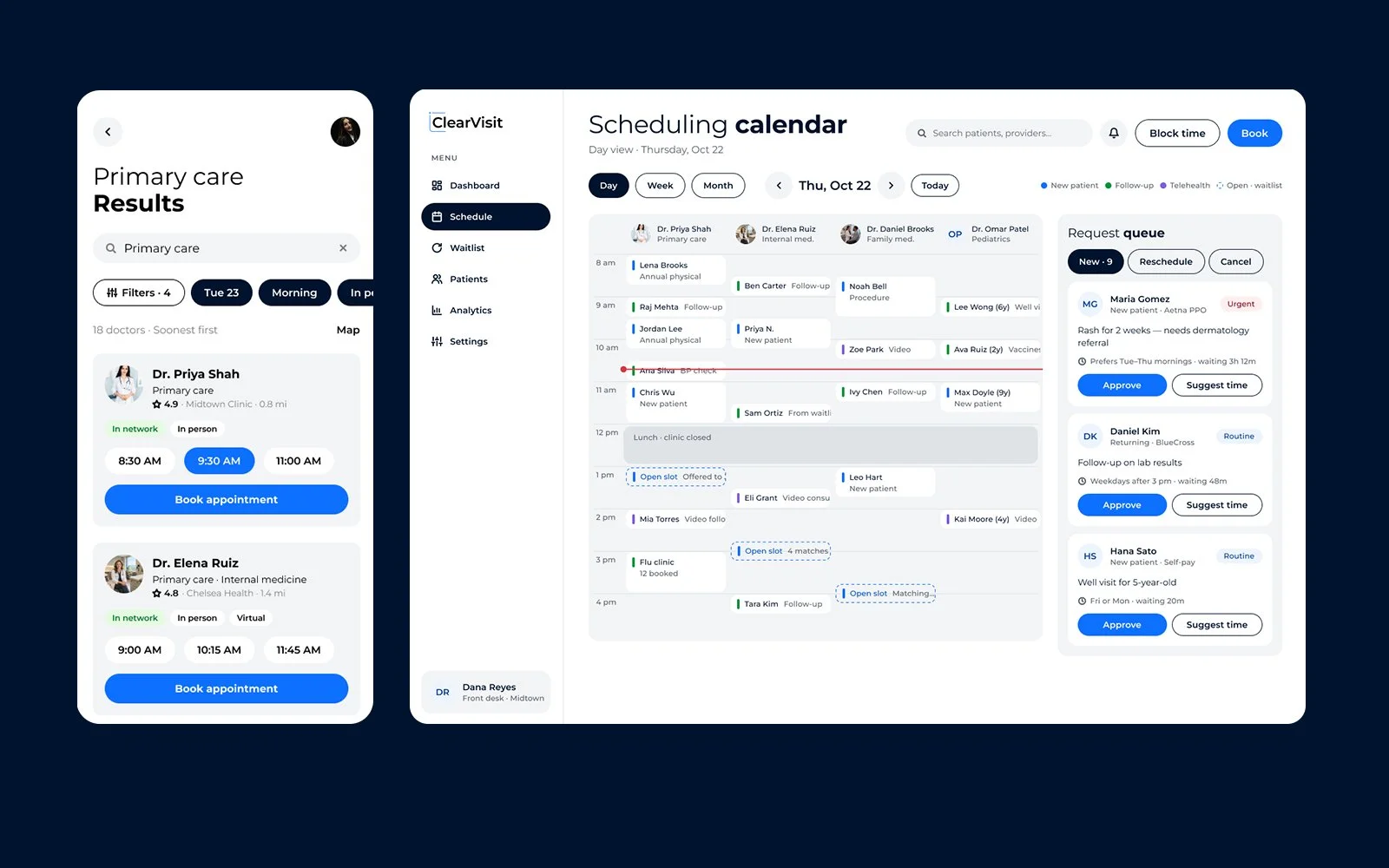
With the core visual language established, I used Claude to help transform those design decisions into a structured design token system. Rather than defining styles and components individually, this approach helped me establish reusable design rules that could scale across both platforms. The result was a more unified design foundation that promotes visual consistency, simplifies future updates, and supports a more efficient design-to-development workflow.